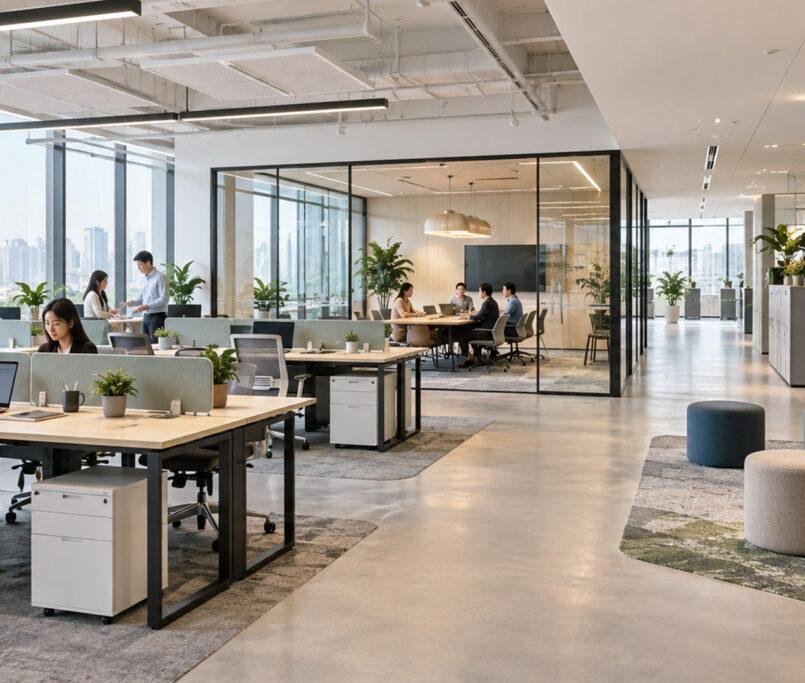
What Makes a Commercial Interior Feel Trustworthy?
Key Takeaway
- Trust in commercial interior design comes from spatial coherence, not from spending more.
- A space feels credible when finish quality, brand identity, and spatial logic all tell the same story.
- Inconsistency between elements, not low budget, is what makes a commercial interior feel provisional.
- Brand identity only works physically when it’s embedded in design decisions, not applied to surfaces.
- The gap between what a space promises and what it delivers is where client trust is most often lost.
Introduction

Walk into two offices in the same building, similar budgets, similar square footage. One feels like a place you’d trust. The other feels slightly off, and you couldn’t explain it if someone asked.
It’s not about money. Some businesses spend heavily on their commercial interior design and end up with a space that quietly unsettles the people walking into it. Others spend less and create somewhere clients genuinely want to sit down and talk. The difference is almost always whether the space feels like it was thought through as a whole, or put together piece by piece with no through-line.
Your physical space says something about your business to every person who walks in. It does that before you’ve said a word.
Why Finish Consistency Matters More Than Finish Level
Your clients aren’t going to inspect your joinery or check whether the partition wall aligns with the ceiling grid. But they’ll notice, without knowing they’re noticing, whether the space feels finished. A place where every area was handled with the same level of care feels settled. A place where some areas clearly got more attention than others doesn’t, even if the client couldn’t tell you exactly why.
In business interior design, every surface is a decision. A door handle that looks out of place, a ceiling detail that wasn’t quite resolved, a cable run that was supposed to be tidied up. On their own, each one is minor. Together, they leave an impression.
A mid-range fit-out with consistent decisions throughout will usually come across as more professional than a higher-budget one with obvious gaps. Research on how office design reflects organisational character supports this. The offices people find most credible are the ones that actually feel like the business inside them.
A commercial interior that handles every detail at the same standard quietly tells visitors that the business behind it works the same way. An unfinished corner, repeated, makes the opposite argument.
What Are the Design Signals That Build or Erode Client Trust?
Trust is easier to notice when it’s absent. The table below outlines the specific things visitors pick up on, and what each looks like when it’s working versus when it isn’t.
| Signal | What Builds Credibility | What Erodes It |
| Finish consistency | Same quality standard across reception, corridors, and meeting rooms | Premium finishes where clients arrive, shortcuts in areas they also pass through |
| Spatial scale | Furniture sized to the room; ceiling height used well | Oversized pieces in a tight space; dropped ceilings where height would have helped |
| Joinery resolution | Clean edges and aligned junctions throughout | Cabinet gaps, mismatched handles, fixings that don’t belong |
| Brand presence | Brand woven into the layout and material choices from the start | Logo on a wall that has nothing to do with the rest of the design |
| Spatial legibility | Clear focal point at entry; logical path through the space | No obvious place to go when you walk in; no one to approach |
| Maintenance | Surfaces that age well and are clearly looked after | Scuffed skirting, dead plants, prints hung at different heights |
Why Brand Experience Design Should Start at the Brief, Not the Feature Wall

Most commercial fit-outs treat branding as something you sort out near the end. The main design is done, then someone asks about adding the logo and the company colours. You end up with a space that has a brand on it rather than one that actually feels like the business.
The spaces that feel most credible are the ones where brand experience design shaped decisions that were made much earlier. Things like how open the layout is, what materials were chosen, and how much natural light gets in. A business that values precision should have that precision in how the joinery details were handled. One that wants to feel approachable should have that in how easy it is to navigate the space when you walk in. These aren’t decorating decisions. They’re brief decisions.
Cactus Art approaches commercial fit-outs for Singapore businesses this way. The brand and the space get built together. A business interior design that works on that level doesn’t have to announce anything. Clients figure it out on their own.
When the brand only shows up on the walls, it hasn’t been built into the space. The offices where it genuinely works are the ones where every decision, from the floor plan to the finish schedule, was made with the same thinking behind it.
What Happens When Your Commercial Interior Contradicts Your Brand?
Commercial interior design creates a trust problem less often because a space looks bad, and more often because it says one thing while delivering another. A reception that looks sharp, followed by a dim corridor with scuffed walls. A confident company name on the door, and inside, a fit-out that feels like it hasn’t been touched in years. These gaps are small on their own, but clients notice them.
It’s not something they’ll raise. They’ll just arrive with a slightly lower baseline of confidence than they would have otherwise. That’s the version of the meeting you want to avoid.
Cactus Art’s guide on selecting materials for office interiors covers how the right material choices affect how a space holds up over time, and whether it still looks like it represents the business five years after the fit-out, not just on day one.
Does Your Space Build or Undermine Trust?
Try walking into your own office as if you’re a client visiting for the first time. Not checking whether it looks designed. Checking whether it feels like one place.
Does the finish quality stay consistent past the reception, or does it drop off? Does the brand feel like it belongs to the space, or was it put there afterwards? Does the path from the front door to the meeting room make sense, or does it feel like a series of unrelated rooms? The areas where something feels off are the areas worth looking at.
This doesn’t always require a full renovation. Sometimes it’s a handful of decisions that are creating the contradiction, and those can be addressed specifically. That’s the kind of conversation worth having at the brief stage, before anything gets built. A good commercial interior design team can help map where those gaps are and what it would take to close them.
Frequently Asked Questions

1. What makes a commercial interior feel trustworthy to clients?
Coherence. A space builds credibility when finish quality, spatial scale, brand presence, and design logic are consistent throughout, rather than concentrated in the areas clients see first.
2. How does business interior design affect client perception?
The space sets a tone before anyone says anything. A fit-out that feels inconsistent or misaligned with the brand gives visitors a reason to quietly lower their expectations before the conversation starts.
3. What is brand experience design in a commercial interior?
It’s about making sure the brand informs the design decisions that matter, not just the decorative ones. When it works, the space reflects the business through layout, materials, and detail. Not just through what’s on the walls.
4. Does coherence matter more than budget in commercial interior design?
Generally, yes. Visitors pick up on whether the space feels considered, not on what individual elements cost. A consistent mid-range fit-out usually makes a stronger impression than a higher-budget one where some areas were clearly treated as an afterthought.
5. What should I look for when reviewing my office for trust signals?
Walk through the areas clients actually pass through, not just the reception. Check whether the finish quality holds up throughout, and whether the brand feels like it belongs to the design rather than being added to it. Where it drops off, that’s usually where the impression drops off too.
Some offices make people feel confident the moment they arrive. Others introduce doubt quietly, and no one mentions it. The difference usually isn’t the budget. It’s whether the space was put together with a consistent idea behind it, or assembled without one. If you’re looking at a commercial fit-out in Singapore and want to get that right from the start, the Cactus Art team can help work through it with you.