A Complete Guide to Different Types of Light for Your Offices
Key Takeaways
- The impact that lighting has on the ambience of an office space is felt before any of the decor even comes into consideration. The brightness levels, colour temperatures, shadows, and placement of lights contribute to the overall ambience of an office environment without anyone having to really notice it.
- The use of layered lighting will make the office environment more harmonised. Using only overhead lights may result in a very plain environment. However, using ambient, task, and accent lighting helps to add depth in the workplace.
- Natural daylight changes how colours and materials are perceived. Wood finishes, textured walls, glass partitions, and fabrics all respond differently depending on the type of light surrounding them. Good lighting planning often improves material warmth and spatial clarity simultaneously.
- Different office areas benefit from different lighting approaches. Reception spaces, meeting rooms, workstations, and collaborative areas usually require different lighting intensity and atmosphere. A single lighting style rarely supports every function equally well.
- Lighting comfort matters in compact Singapore offices. In smaller layouts, glare, uneven brightness, or poorly positioned fixtures can make interiors feel visually tiring surprisingly quickly. Thoughtful lighting placement often improves spatial comfort without major structural changes.
Introduction
Lighting plays an implicit role in creating a comfortable office interior ambiance over time. A well-lit office space tends to be perceived as more relaxed, visually appealing, and welcoming even prior to perceiving any design elements and furniture pieces within its interior. In commercial spaces where prolonged work is done in front of computer screens, lighting choices are likely to play a crucial role in determining comfort level and general atmosphere.
Harvard Business Review – Survey: What Employees Want Most from Their Workspaces notes that according to a survey conducted among 1,601 employees in North America, air quality and lighting emerged as key determinants for both productivity and employee workplace satisfaction. The article stresses that the importance of environmental comfort variables such as brightness, glare, and overall visual environment affects the perception of office spaces.
In Singapore offices where tight spacing and extensive use of computer screens is common, lighting choices have an especially significant effect on the office space’s comfort level. This blog post will discuss various kinds of light sources and their roles in creating office interior ambiances.
Why Lighting Shapes Office Atmosphere?

The impact of lighting in the office will first be emotional before it turns visual. The over-lit environment might make people feel like it is clinical and even exhausting despite its attractive design. In contrast, a good lighting plan will always generate relaxation effects without being too elaborate.
This happens because lighting influences:
- Shadow depth
- Colour perception
- Visual rhythm
- Contrast
- Material warmth
- Spatial clarity
Various types of lighting also influence how employees move around within their offices. Areas such as reception would need soft lighting transitions compared to workstation areas that would need some degree of control over their lighting.
In commercial interiors of Singapore where the interior spaces tend to be compact, proper lighting becomes even more crucial since brighter spaces may become more overwhelming in such spaces compared to larger interior spaces.
Ambient Lighting vs. Task Lighting
In office spaces, the most common type of lights to create an ambience are ambient and task lights. Ambient lighting is the general lighting that exists within a space. Such lighting can be created with ceiling lights, recessed lighting or indirect lighting.
Task lighting functions differently. Instead of illuminating entire rooms, it supports specific activities such as:
- Reading
- Computer work
- Presentations
- Meetings
- Focused desk tasks
Desk lamps, directional lights, and movable workplace lights fall into this category. The issues that emerge occur because such workplaces depend solely on one category of lights. Too much ambient light might make an interior lose its depth, whereas a lack of balance with respect to task lighting will result in harsh shadows and bright lights.
The most refined office interiors typically layer multiple types of lights together rather than depending on uniform brightness throughout the entire workplace.
Discover More : Adopting Wabi Sabi Interior Design Aesthetics for Retail & Office Workspaces
Accent Lighting and Decorative Lighting

Accent lighting introduces emphasis and depth rather than general illumination.
This type of light commonly highlights:
- Textured walls
- Shelving
- Branding features
- Artwork
- Architectural surfaces
- Display areas
The lack of accent lighting could mean that office space lacks visual interest despite high-quality materials. The function of decorative lighting is somewhat different. Pendants, sculptured lights, and artistic luminaires add more visual impact and make more significant contributions to the character of interior spaces.
In particular, reception areas are especially likely to feature decorative fixtures that will create an immediate first impression at the point of entering. It should be said that the effect of decorative lighting is best achieved in the context of balanced functional lighting.
Many successful Singapore office interiors to create more layered environments combine:
- Ambient lighting
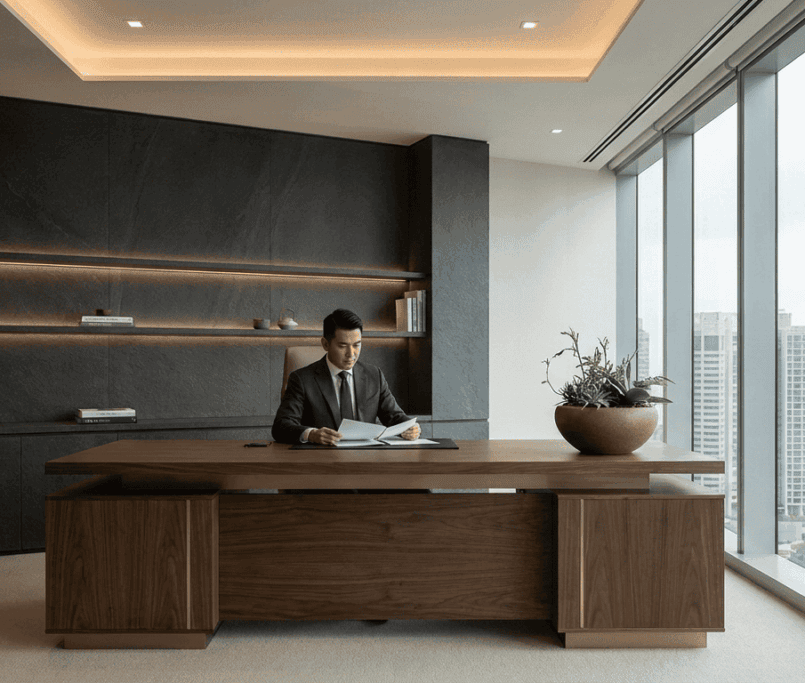
- Concealed lighting
- Accent illumination
- Focused task lighting
Warm Lighting vs. Cool Lighting
Colour temperature changes how office interiors feel psychologically.
Warm lighting typically introduces softer yellow or amber tones. It often creates calmer and more relaxed environments, particularly within:
- Lounge areas
- Waiting spaces
- Hospitality-inspired offices
- Collaborative corners
Cool lighting appears brighter and crisper visually. It is commonly associated with:
- Meeting rooms
- Focused workstations
- Conference areas
- Task-heavy environments
However, excessively cool lighting can sometimes feel harsh when overused across entire offices. The relation between the materials’ finishes and the nature of light is also very crucial. Wood finishes generally have better appearances when illuminated by warm lights.
Stone, glass, and metals usually react to lights depending on their strength and temperature. In most workplaces within Singapore, a combination of both warm and cool lighting is equally used.
Natural Daylight and Spatial Perception

Lighting also affects the appearance of colorus, shadows, and textures at various times during the day. Natural daylight remains one of the more influential lighting elements within commercial interiors.
Offices receiving balanced daylight exposure often feel:
- Visually larger
- Calmer
- More breathable
- Less enclosed
Glass partitions, reflective surfaces, and lighter walls are often better methods of allowing daylight to reach deep into interior spaces. But too much daylight without proper glare control would cause discomfort around screens and workstations.
Hence, it is no wonder that blinds, sheer curtains, and indirect lighting are still important in many Singapore office buildings due to sunlight and high humidity levels indoors.
Of all the forms of lighting used in designing office interiors, daylight becomes highly effective when integrated carefully with other artificial lighting sources.
Read the Full Guide : How to Remove Formaldehyde After Renovation? The Ultimate Guide for 2026
Lighting for Reception and Meeting Areas
Reception spaces usually require a different lighting atmosphere compared to workstation zones. The reception area often introduces the visual tone of the entire office, which means harsh overhead brightness may feel uninviting despite clean furniture or refined finishes.
Layered lighting within reception zones commonly includes:
- Concealed lighting
- Feature pendants
- Wall washing
- Accent illumination
- Softer indirect brightness
Meeting rooms involve different priorities. Visibility remains important, but lighting also affects concentration and comfort. Overly bright conference rooms can feel visually draining during extended discussions, while dim spaces may reduce attentiveness and clarity.
Different types of light support different behavioural experiences depending on how the room functions throughout the day.
How Lighting Interacts With Materials and Textures?
Lighting does not exist independently from interior materials. It changes how every surface is experienced visually.
Textured laminates, fluted panels, timber veneers, and stone finishes all respond differently depending on:
- Brightness direction
- Colour temperature
- Shadow depth
- Reflective quality
For instance, the use of hidden lighting tends to reduce the effect of textures on walls by using shadowing, whereas lighting from directly above would have flattened out the wall texture.
In addition, reflective materials such as glass and polished stone would create glare depending on how the light fixtures are installed. This is significant in Singapore’s small office space.
A thoughtful type of light selection supports both material expression and long-term visual comfort simultaneously.
Common Lighting Mistakes in Offices

Some lighting problems become noticeable only after employees begin occupying the space regularly. One common issue involves excessive uniform brightness. Offices filled entirely with equally bright ceiling panels often lack visual depth and feel tiring over longer periods.
Other frequently seen issues include:
- Glare reflecting onto screens
- Poorly positioned task lighting
- Insufficient daylight balancing
- Overly cold colour temperatures
- Decorative fixtures without functional support
Compact layouts sometimes worsen these issues because lighting intensity becomes concentrated within smaller areas. Rather than increasing brightness excessively, many successful interiors focus on balance between the various types of lights distributed throughout the office.
Why Layered Lighting is Important in Commercial Interiors?
The layering technique ensures that one can transition smoothly between each area, while the entire office does not look monotonous. The reception area, collaboration corner, workstation, and executive suite requires varied light intensities.
Instead of relying on one dominant source, layered lighting combines:
- Ambient illumination
- Task-focused brightness
- Accent features
- Decorative elements
- Natural daylight
This combination can result in a space that is more flexible and visually comfortable to spend more working hours.
Offices in Singapore that need to accommodate limited space and multi-purpose usage may benefit from strategic planning of lighting arrangements without requiring substantial renovations to their spaces.
Conclusion
Lighting affects not only the functional aspects of an office but also other elements such as mood, ability to focus, warmth of materials, and even the spatial perception within the working environment. Lighting in office interior design is typically multi-layered. It may work subconsciously in the background yet be responsible for creating a feeling of either balance or discomfort.
Appropriate application of different kinds of lighting can enhance functionality and also the atmosphere of the office interior, especially when the spaces are limited, like in Singapore office design.
Since 1993, Cactus Art has been delivering 30+ years of office, commercial, F&B, and residential interior know‑how across Singapore. From pre‑design planning to construction supervision, their team handles every stage under one roof, ensuring a smooth renovation journey.
Supported by bizSAFE Level 3 accreditation and 2 industry awards, Cactus Art builds practical interiors with real care for detail—materials, lighting, and day‑to‑day workflow.
Talk to Cactus Art today and start shaping a workspace that feels inviting, refined, and centred around daily comfort.
FAQs
- What are the main different types of light used in offices?
Ambient lighting, task lighting, accent lighting, decorative lighting, concealed lighting, and natural daylight are among the most commonly used office lighting categories.
- Why is layered lighting important in office interiors?
Layered lighting creates better visual balance by supporting different workplace functions instead of relying on uniform brightness throughout the office.
- Which type of lights work best for compact offices?
Concealed lighting, task lighting, and balanced ambient illumination usually work well because they reduce visual heaviness while improving comfort.
- Does lighting affect workplace productivity?
Lighting influences concentration, glare levels, visual comfort, and spatial atmosphere, all of which affect how comfortable employees feel during work.
- How does natural daylight interact with artificial type of light in offices?
Natural daylight often works best when balanced alongside artificial lighting to reduce glare while maintaining visual consistency across the workspace.