Understanding Contemporary vs Modern Office Interior Design for Your Workspaces
Key Takeaways
- The difference between contemporary vs modern interior design is significant in a commercial brief: confusing the two leads to misaligned concepts and costly fit-out revisions.
- Modern design is a fixed historical style rooted in the early to mid-20th century Bauhaus and Modernist movement; contemporary design is whatever is current right now.
- Modern offices favour straight lines, natural materials, and a timeless minimalist logic; contemporary offices favour curves, flexible layouts, and evolving material choices.
- The right choice depends on your brand identity, team size, and how your workspace will change over the next five years.
- Many Singapore commercial fit-outs blend both styles into a single approach, combining the structural clarity of Modernism with current material and technology choices..
Introduction
A client walks into a design consultation and says they want a modern office. The designer begins sketching clean geometric lines, warm timber panelling, and a restrained material palette. Two weeks later, the client reviews the concept and says it’s not what they had in mind. They wanted something more current. More dynamic. Something that looks like it belongs in 2026.
This disconnect happens more often than most business owners realise. “Modern” and “contemporary” are the two most commonly conflated terms in interior design, and the confusion costs real time and money. In a commercial fit-out context, briefing the wrong aesthetic direction means revised drawings, extended timelines, and sometimes rework after construction has started.
Understanding contemporary vs modern interior design is not just a vocabulary exercise. It’s a practical briefing skill that helps business owners communicate precisely with their design team, choose a direction that serves their brand, and avoid expensive misalignments before a single wall is touched.
What Is the Difference Between Contemporary and Modern Interior Design?

Contemporary vs modern interior design describes two distinct design philosophies that share some visual similarities but come from entirely different origins.
Modern interior design is a fixed historical style. It emerged from the Bauhaus and Modernist movements of the early 20th century, roughly the 1920s through the 1970s. Its defining principle is “form follows function.” It favours clean lines, natural materials like wood and stone, geometric shapes, and a neutral palette. Modern design does not change. A modern interior in 2026 looks the same as a modern interior in 1995 because it refers to a specific era, not the present moment.
Contemporary interior design, by contrast, is not fixed. It refers to whatever is current. A contemporary office in 2026 features curved forms, warm neutral tones, biophilic elements, flexible furniture systems, and integrated technology. That same office would have looked different in 2010 and different again in 2015. Contemporary design evolves as culture, materials, and workplace expectations evolve..
The Key Differences That Matter in a Commercial Fit-Out
Understanding what separates the two styles at a practical level helps you brief your design team accurately and evaluate proposals with confidence.
Lines and Forms
Modern design is geometric and angular. Furniture sits low, with clean horizontal profiles. Walls are flat. Architectural details are precise. Nothing curves for its own sake. Contemporary office design introduces fluid forms: curved reception desks, arched partitions, rounded meeting room pods. These are not decorative choices; they reflect how contemporary spaces are designed to feel less institutional and more human.
Materials and Finishes
A modern office uses natural materials: solid timber, leather, stone, and chrome. Finishes are honest. What you see is what the material is. A modern contemporary office mixes materials more freely. Polished concrete alongside warm oak. Mixed metal finishes. Sustainable and recycled surfaces alongside traditional stone. Textured plaster walls beside glass partitions. The palette is warmer than the cool greys that defined contemporary offices a decade ago.
Colour
Modern commercial interiors work within a disciplined neutral palette: whites, warm greys, teak browns, and the occasional bold accent on a single wall or piece of furniture. Contemporary palettes in 2026 are warmer: terracotta, sage green, warm white, and muted earthy tones. Black returns as a strong accent in fixtures, frames, and joinery hardware.
Flexibility and Technology
This is where the two styles diverge most sharply in a commercial context. Modern design prioritises dedicated, purposeful spaces. A meeting room is a meeting room. A workstation is a workstation. Contemporary design treats flexibility as a core design value. Modular furniture, movable partitions, convertible desks, and technology integration are all built into the brief from the start.
“In a commercial fit-out, the style distinction isn’t just about aesthetics. It determines whether the space serves your business for two years or ten. Modern offices age gracefully. Contemporary offices adapt.
How to Identify Which Style Suits Your Business
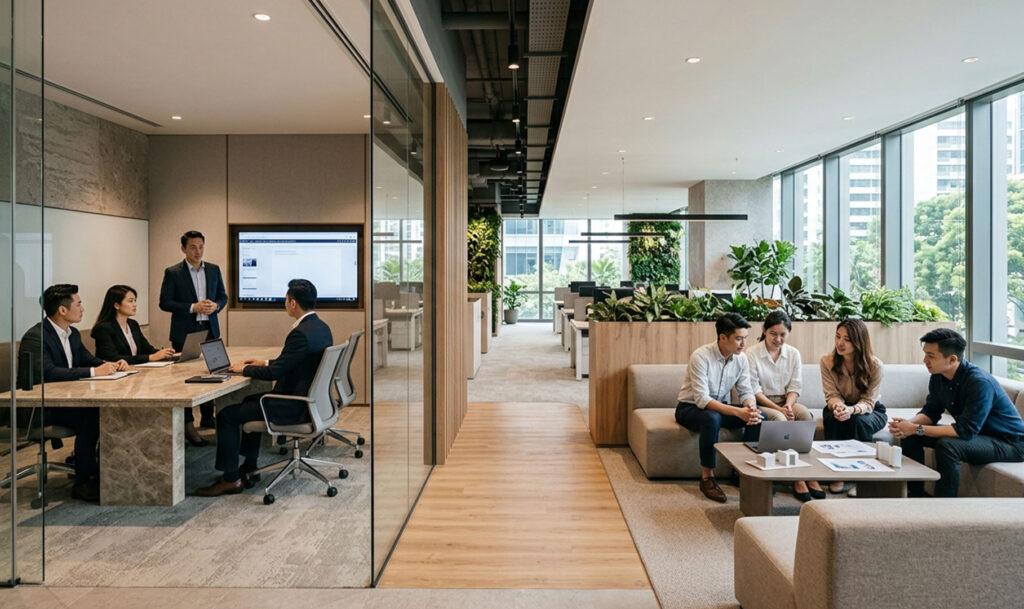
The right choice between modern and contemporary isn’t a matter of preference alone. It depends on your brand, your team, and how your workspace will need to change.
Consider Your Brand Identity
A law firm, a private wealth manager, or a consultancy operating in Singapore’s CBD often benefits from the authority and restraint of modern interior design. The timeless quality of natural wood, stone surfaces, and clean geometry signals established credibility. Clients walking in feel the permanence and precision the business wants to project. A tech company, a creative agency, or a brand that wants to communicate innovation is better served by a blended modern contemporary approach, with its flexibility, warmth, and openness to current material trends. The workspace becomes a signal of how the company thinks about the future.
Consider Your Team Size and Work Pattern
Modern office design suits smaller, more focused teams with relatively stable working patterns. Contemporary office design handles hybrid work better. Its modular layouts, acoustic pods, and flexible zones absorb the fluctuating daily occupancy that hybrid work produces. For Singapore businesses where office attendance varies significantly across a week, contemporary layouts are more operationally practical.
Consider Your Renovation Timeline
Modern design is the better choice if you’re planning a fit-out you want to last fifteen years without feeling dated. Its reference point is a fixed historical era, not current trends. A well-executed modern office doesn’t go out of style. The material quality holds up; the proportions remain right. Contemporary design is the better choice if your business is growing, your headcount is changing, or your brand is actively evolving. The flexibility built into contemporary fit-outs means the space adapts as you do. For Singapore businesses on a three-to-five year lease with renewal options, that adaptability is worth building into the brief from day one.
What Is Contemporary Modern Interior Design?
Contemporary modern interior design is not a third distinct category. It describes an approach that draws on both. A fit-out might use the structural clarity and natural material warmth of Modernism (open plan layout, solid timber joinery, stone surfaces) while layering in contemporary choices: warmer lighting temperatures, curved soft furnishings, biophilic planting, and technology integration. According to Pearl Academy’s analysis of modern vs contemporary interior design, a blended “contemporary modern” approach takes the structural principles of Modernism and layers in current trends and materials.
In Singapore’s commercial interiors, this blended approach is common. Business owners want spaces that feel grounded and professional, but also current enough to attract talent and reflect a forward-thinking culture. The 12 modern office design ideas shaping Singapore workplaces in 2026 at Cactus Art explores how these influences combine in practice. The cleaner, more durable qualities of modern design anchor the space; contemporary choices in materials, lighting, and furniture systems bring it into the present.
“Most Singapore commercial fit-outs don’t have to choose between modern and contemporary. The strongest offices use Modernist structure as the foundation and contemporary material and technology choices as the finish.”
Applying the Distinction to Real Office Spaces
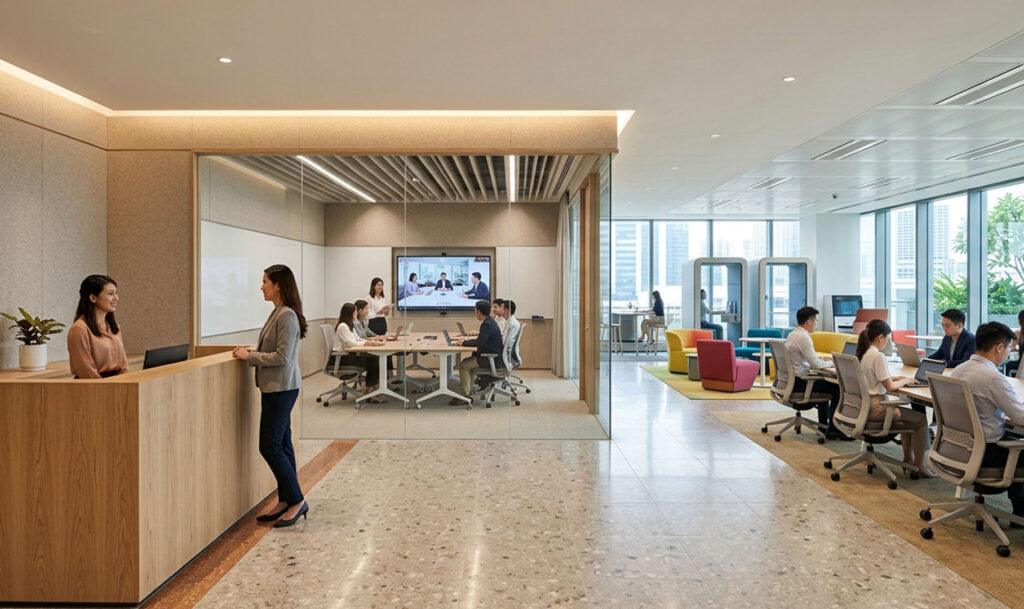
The theoretical difference between the two styles only becomes useful when you apply it to specific briefing decisions.
Reception Areas: A modern reception uses a solid timber desk, stone flooring, and restrained art. A contemporary reception might feature a curved desk in warm white laminate, terrazzo tiles, and a living plant wall. Both can look premium; the choice depends on what your brand communicates at first contact.
Meeting Rooms: Modern meeting rooms have fixed tables, upholstered chairs in leather or wool, and clean wall surfaces. Contemporary meeting rooms often feature modular tables that can be reconfigured, acoustic panels in textured fabrics, and smart glass partitions that shift from transparent to opaque. For Singapore businesses running hybrid meetings daily, the contemporary option is more functional.
Open-Plan Work Areas: In a modern open plan, workstations are permanent and purposeful. In a contemporary open plan, activity-based working means different zones serve different tasks. Quiet focus areas, collaboration benches, informal lounge zones, and bookable pods sit alongside each other. The commercial interior design trends reshaping Singapore offices show how Singapore businesses are adopting activity-based layouts at scale.
Materials and Joinery: Modern joinery uses solid materials and visible construction details. Contemporary joinery is often handle-less, with matte or satin finishes, mixed material combinations, and integrated technology. Both can be fabricated to high standards; the specification depends on which visual language your fit-out is speaking.
Which Side of the Contemporary vs Modern Interior Design Debate Is Right for Your Workspace?
The answer depends on three factors. If your business values timelessness, restraint, and a design that will look as good in 2035 as it does today, modern design is the right foundation. If your business values adaptability, current relevance, and a workspace that reflects how people work in 2026, the contemporary direction is the right call. If you want both, blending modern structure with contemporary materials gives you the clarity of Modernism with the flexibility of current thinking.
Either way, the decision is best made before a brief is written, not after a concept has been presented.
FAQs
- Either way, the decision is best made before a brief is written, not after a concept has been presented.
The distinction between contemporary vs modern interior design comes down to origin. Modern refers to a fixed historical period (1920s to 1970s) defined by clean lines, natural materials, and the “form follows function” philosophy. Contemporary refers to what is current right now and evolves continuously. In 2026, contemporary interiors feature warmer palettes, curved forms, flexible layouts, and biophilic elements. The two styles share some visual overlap, but their origins and principles are distinct. Using the terms interchangeably in a design brief leads to misaligned outcomes and revised concepts.
- Which is better for a Singapore office: modern or contemporary design?
Neither is universally better. Modern design suits businesses that want a timeless, authoritative workspace with a stable layout and natural material quality. Contemporary design suits businesses in growth mode, those adopting hybrid work, or brands that want their workspace to reflect current culture. Many Singapore offices blend elements of both styles into a single fit-out.
- What does “contemporary modern interior design” mean?
Contemporary modern interior design blends the structural clarity and natural warmth of Modernism with current material choices, flexible layouts, and technology integration. It’s not a separate style; it describes a design approach that borrows principles from both without being locked into either. It’s a practical choice for Singapore businesses that want timeless quality with a current feel.
- How does modern vs contemporary design affect productivity in a workspace?
Modern offices tend to produce calm, focused environments through restraint and natural materials. Contemporary offices often score better on adaptability, offering zones that support different work modes across a day. Research cited in Cactus Art’s guide to designing productive workspaces shows that space planning decisions, including layout type, material quality, and lighting, directly affect team output and wellbeing.
- How do I brief a designer on modern vs contemporary for my office?
Start with your brand identity and how you want clients and employees to feel when they enter your space. Then consider your working patterns and how your headcount may change. Reference images are useful, but also specify whether you want permanence or flexibility as a priority, natural or mixed materials, and a neutral or warm colour palette. If you’re leaning toward a modern contemporary direction, note which elements of each style appeal to you most. Bring those decisions to the first briefing conversation rather than leaving them open.
Conclusion
Getting the brief right before construction starts is the most valuable decision a business owner can make in a commercial fit-out. This distinction is not a style preference debate; it’s a business decision that determines how the space serves your team, represents your brand, and adapts to how your company grows. Both styles have genuine strengths when applied to the right business context. If you’re planning a Singapore office fit-out and want to work through the brief properly before committing to a direction, speak with the Cactus Art team about your project goals and timeline.